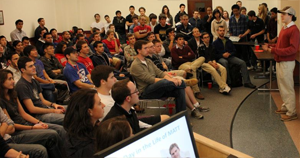
 One of the biggest parts of my job at the Entrepreneurs Club is overseeing event management. At the core of our club is the Get Togethers, which attract 100+ students every week and involve a C-level executive speaking, a hands on skill building activity, networking and feeding everyone in the room a free dinner. If we measured my stress levels there would definitely be a spike on Tuesdays at 6pm.
Event planning and execution is incredibly important, and most organizations need to be good at it in order to engage effectively with their customers. Here is my short list of the keys to putting on great events:
1. You need a hook
Maybe it is a high profile speaker, a fancy free dinner or a sexy venue. Either way, there needs to be something attached to the name or description of the event that immediately entices people to come. The events that my team put on focus on the speaker as the hook. My rule of the thumb is that for every event, I need to hit all 3 of the following requirements:
- A big name speaker or company
- An impressive number to attach to that speaker
- A speaker that is high energy and knows how to give great talks
For example, “Featuring the CEO of Au Bon Pain, a $250M casual cafe chain that was named one of the healthiest restaurants in America.”
2. Logistics need to be smooth
One of the biggest mistakes folks make is underestimating the amount of little details that go into the logistics of putting on a great event. What time will the speaker arrive? Will they know how to get from the parking garage to the room? How are the chairs being set up? All of these details must be taken into account. Ideally, there should be someone on your team with a “Director of Operations” title who takes on full responsibility (with an assistant) for all of these items.
3. Timing is everything
I break events down to the minute. That means I know what is happening at 6:05 and 6:07. You need to take into account delays like people coming in late, standing up to get food, etc. Don’t underestimate these because they can add up. Before each event, I create what I call a “Logistics Schedule” that breaks down minute by minute what is happening, who is responsible for it, etc and I share it with my team. For example:
6:00 – 6:05 – Greet members – Entire team
6:05 – 6:07 – Member of the week announcement – Matt
And so on. This way, there is never any confusion for where we are in the progress of the event or where we need to be going at any given period of time during the event.
4. You can’t do it alone
Event planning is not a one person job. If you want to do it well, it needs to be team based. That means one person is responsible for the technology/media in the room, another person gets the food, and another escorts the speaker. Make sure that everyone on the team understands exactly what their roles are and what the action items / deliverables are for them during the event.
5. A boring speaker means that YOU are boring
If your organization is putting on an event, then you and you alone are responsible for every detail, both the good and the bad, that happens at the event. If you bring in a speaker and they speak in a monotone voice, droning on about random nonsense that has nothing to do with your event, here’s what’s going to happen: the people in the audience will think to themselves, “wow, (your organization) sucks!” That’s right, they won’t say “wow, this speaker sucks!” You get blamed. This means that you need to be on top of everything that happens and exert tight control over who gets to speak to the people at your event.
6. Food is a necessity
Every good event has food, and it must be free for attendees (or at no additional cost if they paid a fee to attend the event). Few things warm the human soul more than free food. I’m not saying you need lobster… keep it simple. But feed your attendees and they will be shockingly happier.
7. There has to be engagement
People’s attention spans are surprisingly short. Esspecially if you are targeting a younger demographic (ie people in their 20s), guess again if you think they’ll enjoy sitting through a 60 minute speaker. No way. Every good event has to be broken up into different chunks of activities.
When I plan events, I use the rule that attendees are never doing the same thing for much longer than 20 minutes. We keep it exciting and shift focus. All of our Entrepreneurs Club activities start with food and networking, then go to a hands on skill building activity, then to a speaker, then to Q&A and finally back to networking. It’s a solid framework and it works.
8. Leverage the F**k Factor
Particularly for younger audiences, people start paying a lot more attention when whoever is speaking does something that they seemingly shouldn’t. This especially holds true with dropping an occasional F-bomb to the crowd. It generally goes hand in hand with ensuring that whoever is speaking, making announcements, etc is doing it with a ton of energy and enthusiasm.
9. I’d rather “do” than just “listen”
The best events are interactive. That means the attendees aren’t just sitting in chairs the entire time, but instead they become part of the event. Maybe they are creating some plan and pitching it to the group. Perhaps there is a competition involved where attendees break up into teams. Or maybe they just have to answer a question. Either way, people want to be involved, and it will keep their attention. Ultimately, this makes an event more fun.
10. Follow up
Think carefully about the objective of your event. Was it to sell something? Or perhaps you were driving deeper engagement with your customers? Either way, there needs to be a follow up or call to action for attendees. Maybe it is an email sent out after the event with something to check out. Either way, make sure you circle back with your attendees and get their opinions on the event. Ask them what you could have done better and thank them profusely for their feedback.